Cyprus · home market
Building management software made in Cyprus, for every Cypriot building
Allocate the common expenses (κοινόχρηστα), issue the owner statements, collect the payments and keep the lift, fire and insurance records for any building on the island. Cyprus is where Domera was built and the first of 31 European countries it works in.
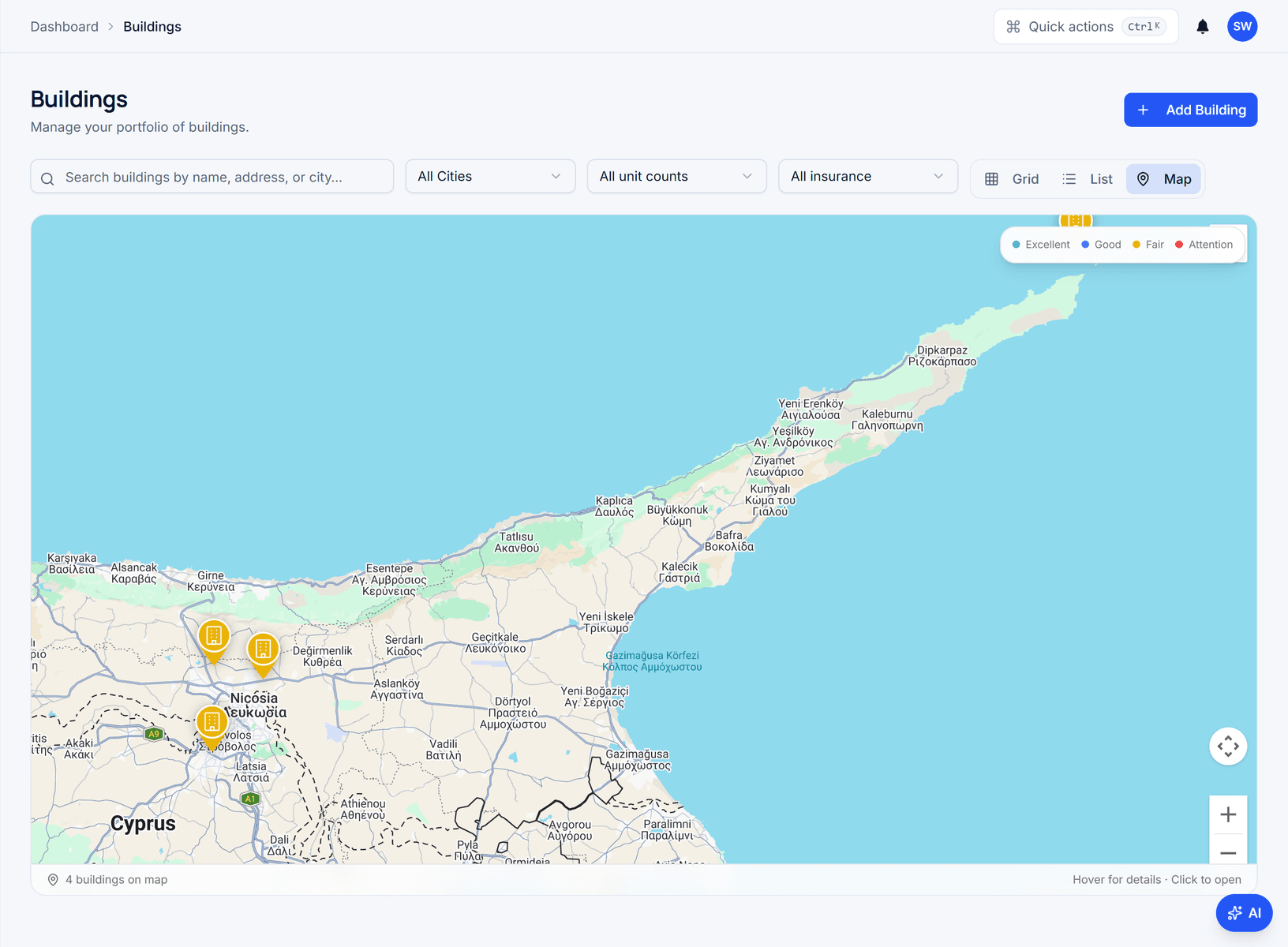
Euro, Cyprus VAT and dd.MM.yyyy dates are the defaults for a Cyprus company; nothing to configure.
What applies across Cyprus
One law, one authority for lifts, two scripts
The rules below hold from Limassol to Paphos. They are general guidance, not legal advice; each names the instrument or the authority to confirm it with.
Who collects the common expenses?
In Cyprus, the Immovable Property (Tenure, Registration and Valuation) Law, Cap. 224, provides for a management committee in every jointly owned building. As we read it, owners contribute in proportion to the area of their units unless the building's registered regulations set a different basis. Confirm the basis for your building with the regulations or a lawyer.
Each expense category carries one allocation method; the allocations are reconciled so they sum to the invoice, to the cent.
How allocation worksWhat happens to arrears when a unit is sold?
In practice, the buyer's lawyer asks for confirmation that the seller's common expenses are settled before the transfer at the Department of Lands and Surveys. Buildings call this a clearance certificate. The wording and who signs it vary from building to building; check what your committee or management company has agreed.
The transfer is balance-gated: the certificate is produced from the owner's ledger and the former owner keeps read-only access to their history.
Ownership transfer controlsHow often is a lift inspected?
Intervals are set nationally. In Cyprus, lift safety in service is regulated by national legislation with periodic inspections by approved inspectors; the Department of Labour Inspection is the competent authority. Confirm the current interval and the list of approved bodies with the authority or your lift contractor.
The Cyprus catalogue applies the recurring inspections to a building in one step; the next due date advances from the recorded inspection, not from the calendar.
Building health and complianceDo Greek names and bank lines print correctly?
Cypriot buildings mix Greek and Latin script: owner names on the title, vendor names on invoices, bank descriptions typed in Greek, Latin or Greeklish. Statements are generated from the same records, so a name written in Greek prints in Greek.
PDF statements use a font verified for all 29 official languages of the EU-27, UK, CH, NO and IS plus Turkish and Greek; imported bank descriptions are parsed for the owner, unit and period.
Statement generation and deliveryLimassol · Cyprus
Buildings in Limassol
Limassol's newer stock is tall and coastal: residential towers along the seafront, mixed-use developments around the marina and Zakaki, and large complexes in Germasogeia and Agios Tychonas. Many hold owners abroad, commercial units beside apartments, and lifts, pools and facades whose upkeep dominates the budget. The allocation, the reserve fund and the owner statement carry more weight here than in a six-unit block.
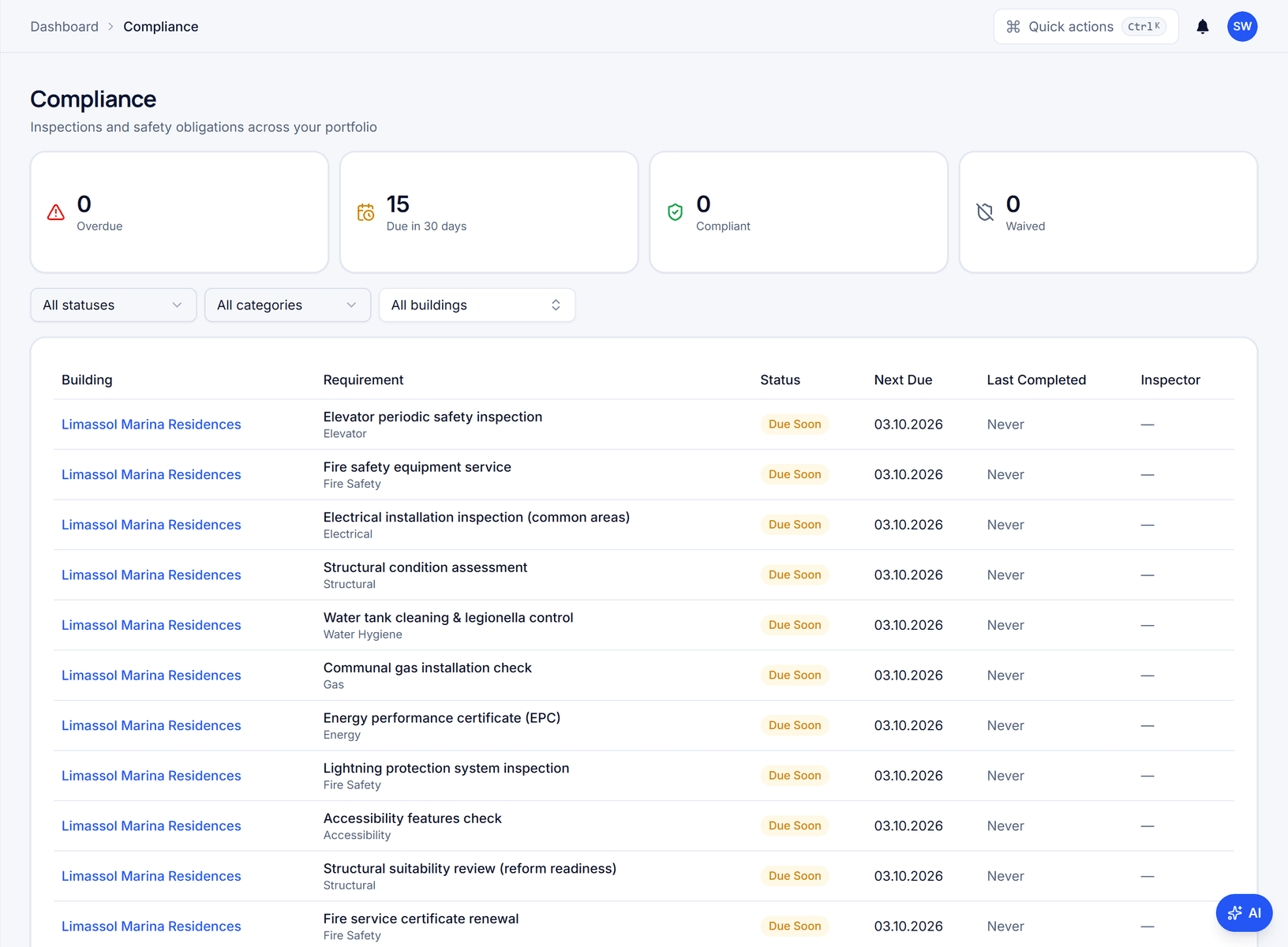
A tower of a hundred units or more typically has several lifts, a pool, a gym, underground parking and a facade that needs periodic inspection and cleaning — expenses that are allocated differently: parking to the units holding a space, the pool to residential units, the lifts by lift share. Mixed-use developments add commercial units with their own opening hours and service needs. Ownership is often international, with a share of units let short-term or held as second homes, so owners are reached online rather than at the door. Management companies here compete on how clearly they can show where the money went.
What comes up in Limassol
- Several allocation methods inside one building — lifts, pool, parking, facade — each on a different share
- Owners in several countries who need the statement online, in a format they can read
- Reserve fund levies large enough for a facade or lift overhaul, and the pull to spend them on this year's running costs
- Lifts and pools that carry periodic inspection and water hygiene obligations
- Commercial units whose share of security, cleaning and insurance is contested
What the product does about it
- Allocation method set per expense category — lift share for the lifts, ownership share for insurance, a custom rule for parking — with cent-exact rounding
- Owner portal scoped to each owner's units, with statements as PDF and email for owners without an account
- Reserve fund with its own levy schedule and its own balances on every statement
- Compliance items for lift inspection, legionella and water tank cleaning, with reminders and the compliance record for the AGM
- Action centre and health score across a manager's Limassol buildings
Nicosia · Cyprus
Buildings in Nicosia
Nicosia's housing is mostly mid-rise: blocks of six to thirty units from the 1970s onwards in Strovolos, Engomi, Aglantzia, Lakatamia and Latsia, with newer developments at the edges and office buildings mixed with apartments around the centre and the government area. Most blocks are run by the owners' own management committee rather than a management company, and the committee changes hands.
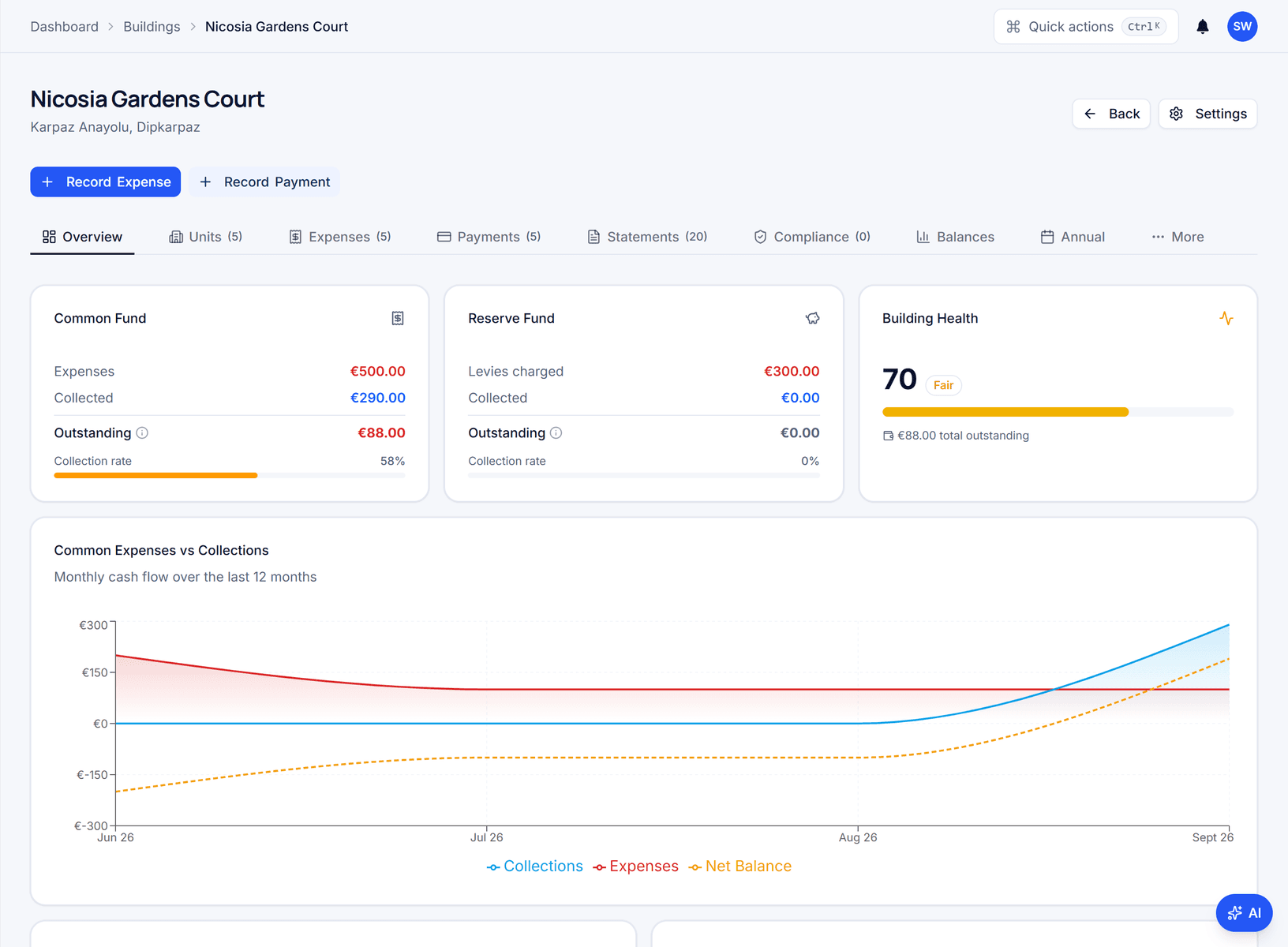
An older mid-rise block tends to have one lift, a shared water supply, in some cases a central heating or fuel arrangement, and a facade or roof now due for work. The committee is typically two or three owners who volunteer; the accounts live in a spreadsheet and a folder of receipts, and the reserve fund, where there is one, often sits in the same bank account as the operating money. Buildings near the centre that mix offices and apartments face the question of how ground-floor commercial units share the lift and the cleaning. Owners are mostly local, so a dispute surfaces at the AGM rather than by email.
What comes up in Nicosia
- A committee that changes at the AGM and inherits a spreadsheet, not an account
- Owners who dispute the lift charge because the calculation is not shown
- Reserve fund money held in the operating account
- Chasing late payers by phone from a list kept by one person
- Ground-floor offices and shops whose share of the lift and common areas is contested
What the product does about it
- Allocation per expense category, with a lift share of zero for ground-floor units where the owners so decide
- Owner statements as PDF with each charge line, and a portal where the owner reads the same figures
- Reserve fund levies and balances kept apart on every statement
- Scheduled payment reminders that state the amount and the statement behind it
- Audit trail with actor, time and values that stays with the building when the committee changes
Paphos · Cyprus
Buildings in Paphos
Paphos holds a high share of holiday and retirement complexes — low-rise developments with shared pools and gardens in Kato Paphos, Universal, Chloraka, Peyia, Tala and along the coast — where many owners are British or from elsewhere in Europe and present for part of the year. The building runs whether they are there or not, so the statement and the reminder have to reach them wherever they are.
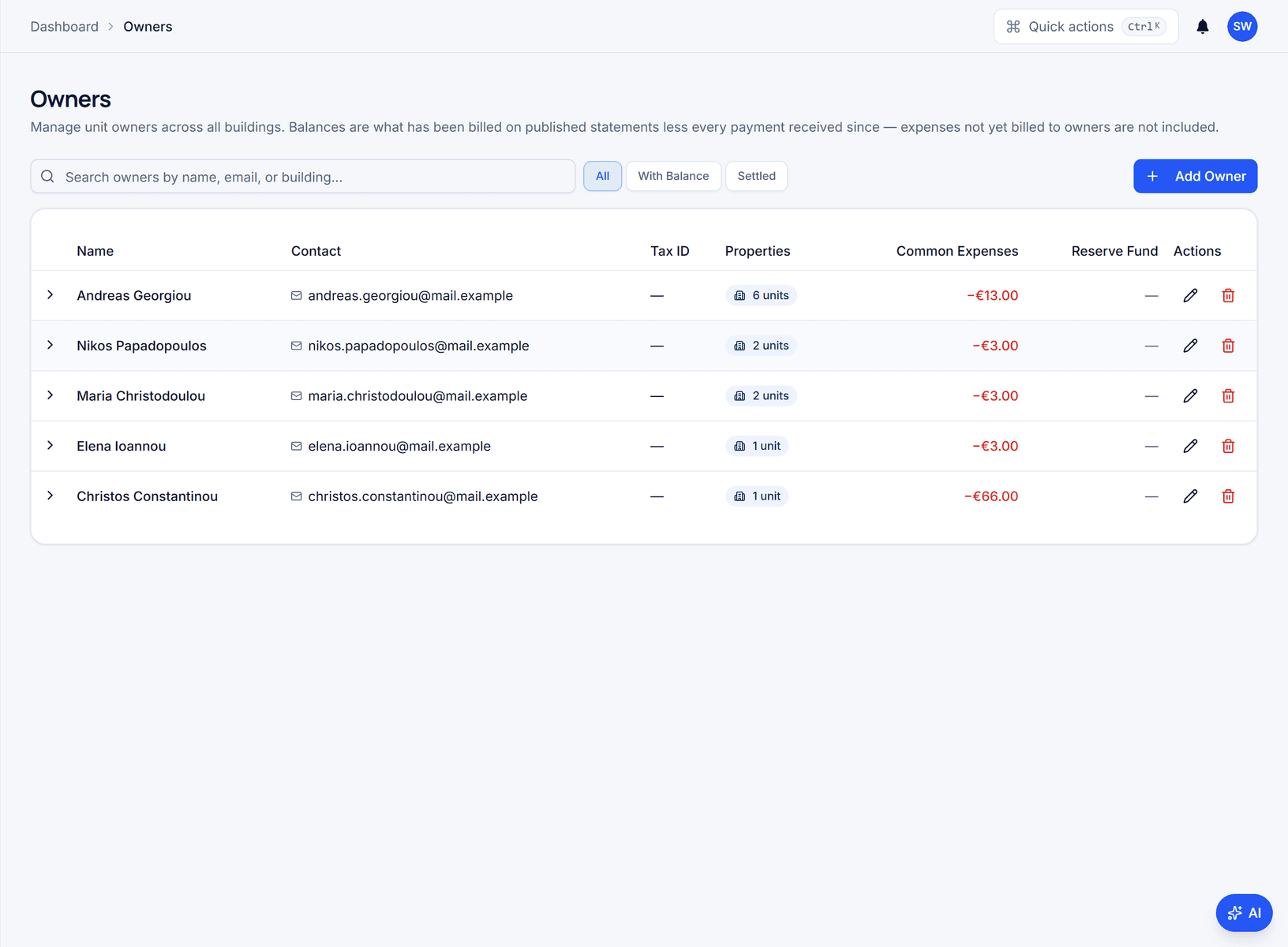
A typical complex has several blocks around a pool, gardens and lighting running all year, and a committee or management company that must collect from owners in several countries and time zones. Communication is often by email to addresses that change, and payments arrive from foreign bank accounts with descriptions that do not name the unit. Some complexes built in the 2000s now face facade, roof and pool-plant work with reserves that were never funded for it. Pools carry water hygiene obligations, and lifts, where present, periodic inspection. Language matters: most owners read English, most vendors invoice in Greek.
What comes up in Paphos
- Owners in several countries who are absent when the levy is set and the AGM is held
- Bank transfers from abroad whose description does not identify the unit
- Pools and gardens with year-round costs and seasonal use
- Reserve funds too small for the works a twenty-year-old complex now needs
- Owners who read English and vendors who invoice in Greek
What the product does about it
- Owner portal in any browser, in any country, with statements as PDF and email for owners without an account
- Bank statement import that suggests the paying owner from the transfer description, with a confidence score (beta)
- Reserve fund levy schedule per building and separate balances, so the works fund is visible at every AGM
- Compliance items for pool water hygiene and lift inspection, with reminders and the compliance record
- Attendance by proxy with the proxy document attached, and votes weighted by share for owners who cannot travel
Larnaca · Cyprus
Buildings in Larnaca
Larnaca is where new buildings are being handed over: developments around the marina and the Finikoudes seafront, along the Dhekelia road and towards the airport and Livadia, many completed in the last few years with the first committee still to be formed. The first year sets the pattern — which share is used, whether a reserve is levied, how owners are told.
A newly handed-over building starts with the developer's unit list and title-deed shares, a set of warranties and service contracts (lift, fire systems, insurance) whose dates matter, and owners who have never met. Local and international buyers sit side by side, and some units are investments, let from the start. The first committee has to choose allocation methods, set a reserve levy for a building with no history, and put the statutory inspections on a calendar before the warranties lapse. Established blocks in the centre and Drosia face the opposite problem: a long history held in a spreadsheet.
What comes up in Larnaca
- No history to set the budget and the reserve levy from
- Lift, fire-safety and insurance dates buried in the handover pack
- Owners who have never met agreeing an allocation method
- Investment units and short lets beside owners who live there
- Management companies taking on several new buildings in the same year
What the product does about it
- Six-step building setup — basics, manager, address, share calculation, categories, access — with opening balances from CSV
- Contract and insurance register with dates read from the handover documents and proposed for confirmation
- Compliance items from the Cyprus catalogue — lift, fire safety, electrical, legionella — with due dates and reminders
- Reserve fund levy set per building from the first month, with its own balances on every statement
- Owner portal from day one, so the first statement is also the first look at the calculation
FAQ
Cyprus questions, answered
- Which law governs common expenses in Cyprus?
- The Immovable Property (Tenure, Registration and Valuation) Law, Cap. 224, governs jointly owned buildings, their management committees and the collection of common expenses. The building's registered regulations add the detail: the allocation basis, what may be charged on late payment and how meetings are called. Confirm anything that affects money with a lawyer or the Department of Lands and Surveys.
- What is a clearance certificate and who asks for it?
- A written confirmation from the building that a seller's common expenses are settled. In Cyprus practice, the buyer's lawyer asks for it before the transfer of title. Domera produces it from the owner's ledger once the balance is cleared and records who issued it in the audit trail.
- How often must a lift in a Cyprus apartment building be inspected?
- Lift inspections in Cyprus are periodic and carried out by approved inspectors under national legislation; the Department of Labour Inspection is the competent authority. Intervals are typically one or two years across Europe. Confirm the current Cyprus interval with the authority or your lift contractor, then record it once and let the due date advance from each inspection.
- Does Domera work for buildings outside Limassol, Nicosia, Paphos and Larnaca?
- Yes. Cyprus is the home market and the settings for locale, currency, VAT and dates apply to every building in the country. The same company can also manage buildings in any other EU country, the UK, Switzerland, Norway or Iceland, each with its own settings.
- Can owners who live abroad use the owner portal?
- Yes. Owners sign in from any device and see their balance, statements, payments and the building's documents. Nothing is posted by hand: the portal shows the same ledger the manager works from.
- Is the reserve fund kept apart from the common expenses?
- Yes. The reserve fund, also called the sinking fund, is a separate ledger with its own contributions and balance. Owner statements show the two apart, so an owner can see what went to running the building and what was set aside for major works.
Start with one building
Run one Cyprus building through it this month.
Start the 14-day trial, add the building, import the owners and post the month's invoices. The statements, the balances and the compliance record follow.
- 14-day free trial
- No credit card required
- Cancel any time