No transfer while the unit owes money

Ownership transfer controls

Transfer a unit only once the departing owner's common and reserve balances are settled, then issue the clearance certificate.

https://domera.cy/dashboard/buildings
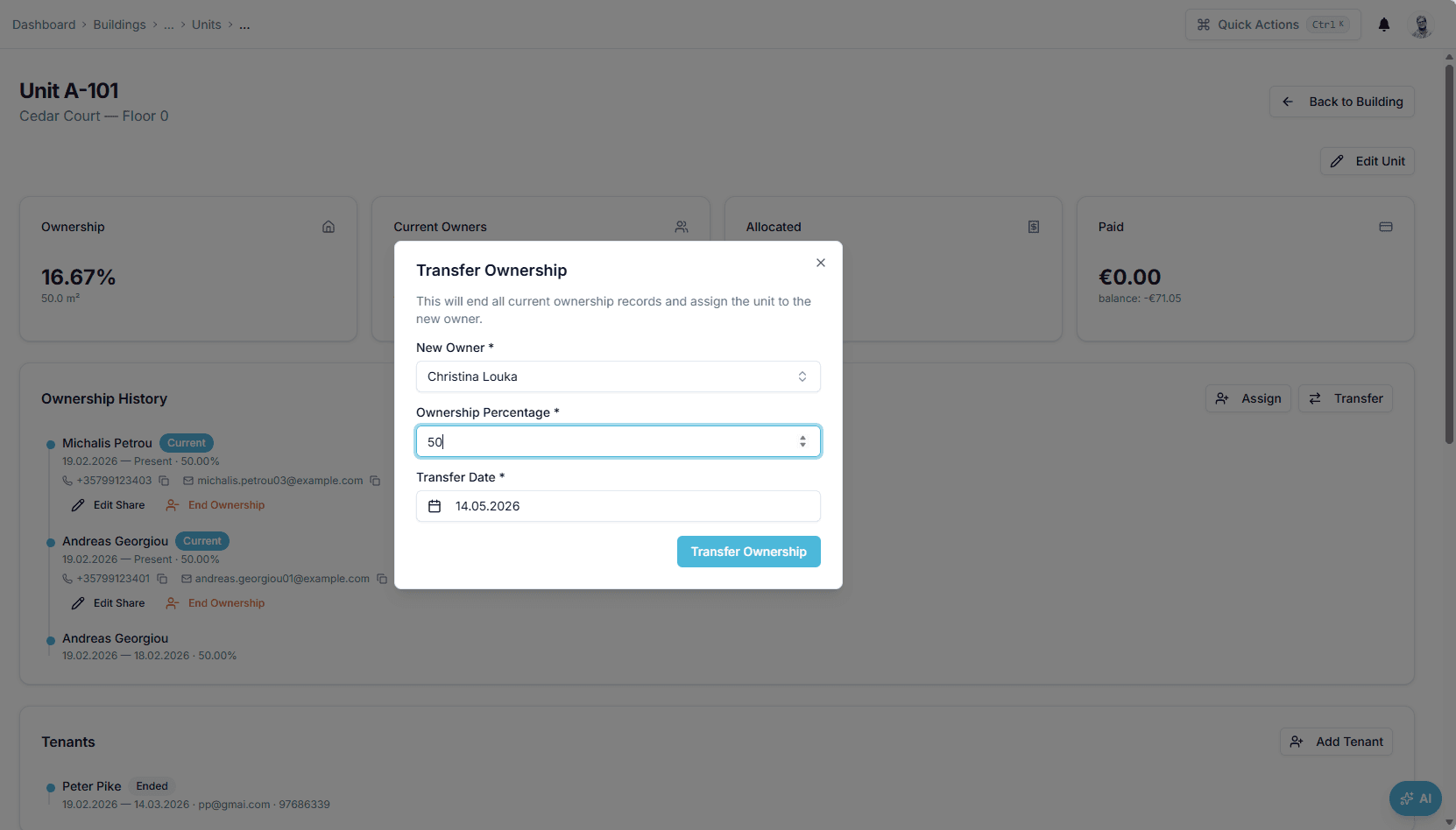
Unit page with the ownership history — two current 50 % owners and one ended record — and a transfer ownership dialog asking for new owner, ownership percentage and transfer date

Interface shown is from an earlier version

Outcome

The transfer is refused while a balance is outstanding, and the certificate is built from the last finalised statement with its issue written to the audit trail.

In practice

Why teams use this feature

What managers and committees tell us it changes in the monthly routine.

  • Hard block: an outstanding common or reserve balance stops the transfer

  • Clearance certificate PDF with per-owner common, reserve and total balances

  • Ownership history kept per unit with valid-from and valid-to dates

  • Balance check covers the common fund, the reserve fund and opening balances

  • Clearance certificate PDF with co-owners, balances and a signature block

  • Ownership history per unit, with valid-from and valid-to dates

  • Partial transfers between co-owners, with the share limit enforced

How it works

What this feature does

Transfer a unit to a new owner and the departing owner's balance is checked first — common fund and reserve fund, including opening balances and levies. Any outstanding amount blocks the transfer with the figures named; a clearance certificate PDF documents the position as at the date. On transfer, the departing ownership record ends the day before, the new owner starts at €0.00, and the history stays on the unit.

01

What happens to the debt when a unit is sold?

It depends on the country. In Cyprus the management committee can typically issue a certificate of outstanding common expenses for the transfer at the Department of Lands and Surveys; in Spain the seller presents a certificate of being up to date with the comunidad (Ley de Propiedad Horizontal, art. 9). Confirm with the competent authority. Either way the manager needs the balance as at a date, per owner, per fund.

02

How the block works

Choose Transfer on the unit. Before anything changes, the departing owners' balances are fetched from the same engine that produces statements — opening balances and reserve levies included. If any is above zero, the transfer is refused with the figures: 'Common fund €71.05, Reserve fund €0.00 (Total €71.05). A clearance certificate is required.' Ending an ownership without a transfer is checked the same way. There is no override button.

03

What the clearance certificate states

Owner, building, unit, ownership share, date, managing company. A balance summary per owner of the unit: share, common fund, reserve fund, total. A status banner — 'Cleared — no outstanding obligations' — and a signature line for the company's representative. A footnote that the certificate reflects the balance as at its date and waives nothing after it. Each certificate carries a number.

04

What the new owner starts with

Every current ownership record ends the day before the transfer date; the new owner's record starts on it with the share you enter. For a full transfer the unit's opening balances are set to €0.00, so the buyer inherits nothing. A partial transfer — one of two co-owners selling — keeps them. The unit's ownership history shows each record with its dates, and the transfer is audited.

In the product

See it on the screen

https://domera.cy/dashboard/owners

Interface shown is from an earlier version

The clearance certificate

Clearance certificate PDF: 'Cleared — no outstanding obligations', owner, building, unit and share, a balance summary per owner across common fund and reserve fund, and a signature line

Related

Keep exploring

  • AI building assistant

    Ask about any building, owner or balance in plain language; the Domera assistant answers from your company's own records.

    Learn more
  • Smart allocation engine

    Allocate every common expense by ownership share, floor area, equal parts, floor level, lift share or a custom rule.

    Learn more
  • Owner portal transparency

    Owners sign in and read their own units' statements, balances, payments, documents, compliance status and meetings.

    Learn more

FAQ

Frequently asked questions

More answers on the full FAQ page.

Can a transfer proceed if the departing owner has an outstanding balance?
No. The transfer is refused with the common, reserve and total figures until the balance is cleared. The same check applies to ending an ownership without a transfer.
Is the clearance certificate accepted for the transfer?
It states the balance per fund as at a date, per owner, numbered and signed by the company. In Cyprus it is worded for the transfer at the Department of Lands and Surveys; elsewhere it serves as the settlement certificate your jurisdiction expects — confirm the required form with the competent authority.
Can former owners still sign in after a transfer?
The portal shows the units an owner holds today, so a transferred unit no longer appears to the seller. Their statements and payments stay on the unit's history for the management company, and the clearance certificate documents the position at transfer.

Start with one building

Ready to put the building's books in order?

Start the 14-day trial, add the first building and run one month through it. Import the owners, post the invoices, issue the statements.

  • 14-day free trial
  • No credit card required
  • Cancel any time