Why a budget year needs an escape hatch
In actuals mode every approved invoice is split between the units and lands on the next statement; there is nothing to decide, the owners pay what the building spent. Budget-levy mode trades that for predictability: the committee approves an annual budget, each owner pays a fixed twelfth of their share every month, and the actual invoices are shown on the statement for transparency without changing anybody's balance. How to read your common expense statement walks through what that looks like.
The weakness is obvious the first time something breaks. A budget is a forecast, and a lift motor, a burst riser pipe, a legal dispute with a contractor or a new fire-safety requirement do not wait for the next AGM. The common fund can carry some of this, and should, but a fund that was sized for ordinary months cannot carry €4,800 in September without the cleaner going unpaid in November.
Regulations across Europe recognise the problem. In Cyprus the management committee may, under the building's regulations and the Immovable Property law (Cap. 224), levy a special contribution for an expense the annual budget did not cover; French co-ownerships vote an appel de fonds exceptionnel, German WEGs resolve a Sonderumlage, Spanish communities a derrama. The names differ, the mechanism is the same: a one-off amount, split by the ownership key, added to what each owner owes.
Three honest options
When an unforeseen invoice arrives, the committee has three defensible ways to handle it. Each is right in some situations and wrong in others, and the choice should be minuted either way.
| Option | When it fits | What owners see |
|---|---|---|
| Absorb it and true up next year | The amount is small against the fund, or the year's other lines are under budget | The invoice in the information section; next year's budget and levy go up |
| Raise the monthly levy | The cost is recurring (a new maintenance contract, higher insurance) rather than a one-off | A higher levy from the next month, with a revised budget |
| One-off extra contribution | A single large cost the fund cannot carry; the committee wants it paid now and visibly | An extra contribution line on the next statement, added to the balance; the invoice is not shown again |
Charging an invoice to owners on top of the levy
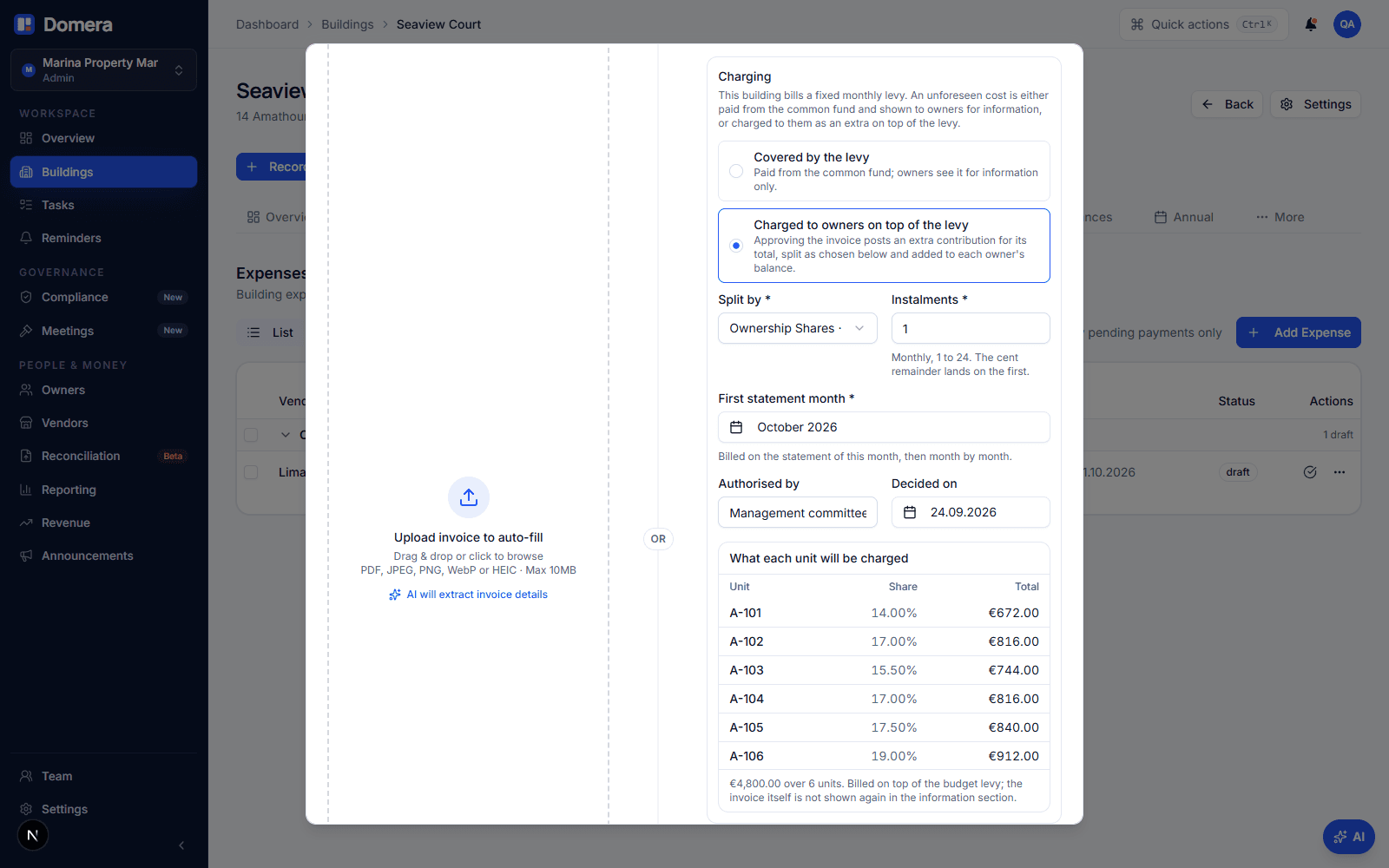
Record the invoice as usual: vendor, description, total including VAT, invoice number and date, the document itself. In a budget-levy building the dialog shows one more block, Charging, with two choices. "Covered by the levy" is the default and is exactly what happened before: the invoice is paid from the common fund and appears on the owners' statements for information only. "Charged to owners on top of the levy" turns the invoice into an extra contribution.
Choosing it reveals the fields the contribution needs. Split by: the allocation rule, pre-selected with the building's usual one and changeable, or the exact amounts already typed when the invoice applies to specific units. Instalments: from one to twenty-four monthly parts, so a €4,800 motor can be spread over six statements. First statement month: the first open month is pre-selected; months closed by a finalised statement cannot be chosen. Authorised by and decided on: who took the decision and when, so the statement can be defended later. Under the fields a live table shows what each unit will be charged, in total and per instalment, computed by the same code that will post the rows.
If the building's approved budget plus this invoice exceed what the budget allowed for the year, a quiet line says so: "This takes the building over budget by €X this year." It is a nudge, not a block; the committee may well know.
What happens at approval
Nothing is charged while the invoice is a draft; the choice and its options are stored on it and can still change. When the invoice is approved, a contribution is created with the invoice's description as its title, the invoice's scope (the whole building, a block or the specific units picked on it) and the rule you chose, linked to the invoice, and posted. Posting writes one levy row per unit and instalment, dated to the statement months, in the same table the monthly budget levy lives in, marked as a contribution. If posting is refused, because the first month is closed or every unit's share would be zero, the approval is taken back and the invoice stays a draft with the reason shown.
From there the ordinary machinery does the rest. The next statement for each unit bills the contribution as a line under the invoice's title, next to the month's budget levy; the owner's balance and amount due include it; ageing and reminders treat it like any other billed amount. The invoice itself is left out of the "actual expenses" information section, because the owner is paying for it directly and showing it twice would read as a double charge. When the statement that bills the contribution is finalised, the invoice locks with it.
Reverting an approved invoice to draft cancels its contribution if none of the rows has reached a statement. If a row is already billed, the revert is refused with the reason: the owners have been invoiced, and the correction belongs on a credit, not on a deleted history.
Standalone contributions and instalments
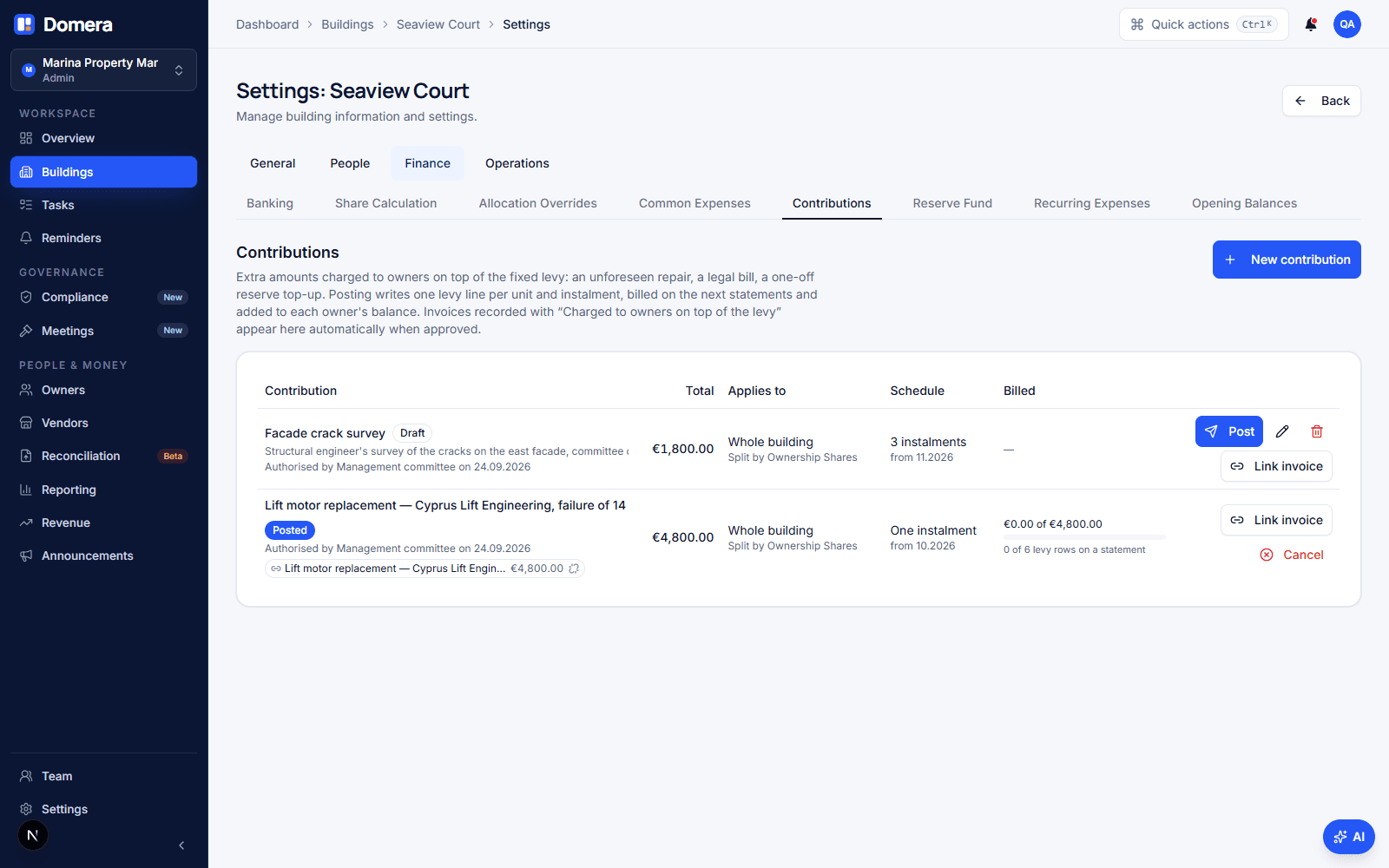
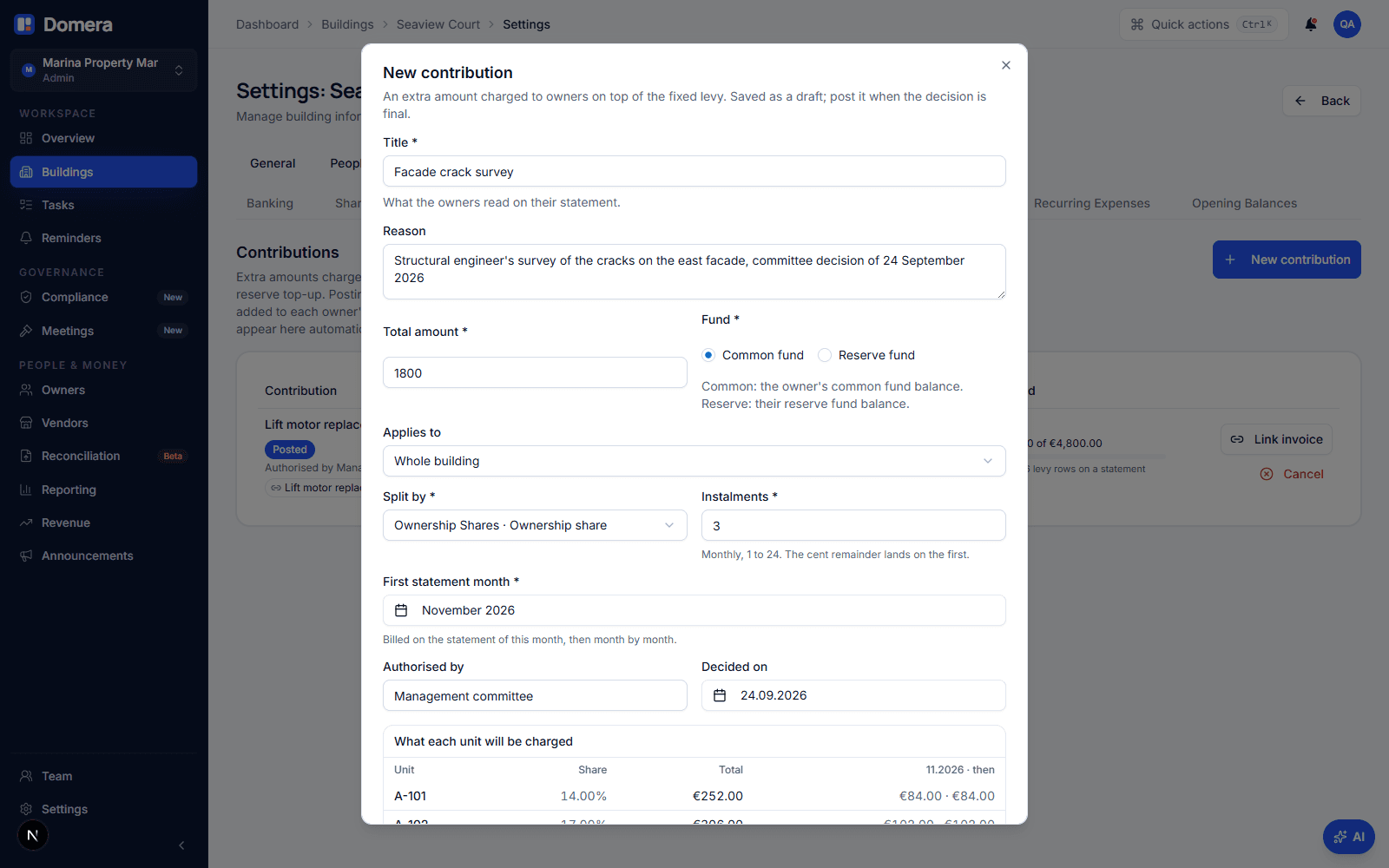
Not every extra starts with an invoice. A reserve fund top-up voted at the AGM, a legal retainer paid in stages, or a repair charged to the two flats that caused it can be created directly under Settings › Finance › Contributions. The New contribution form asks for a title and a reason (both shown to owners), the fund it belongs to, the total, what it applies to (the whole building, an allocation group, or specific units with the rule or exact amounts), the split rule, the instalments, the first statement month and the authorisation, with the same preview.
A contribution is saved as a draft and posted when the decision is final. Instalments are monthly and consecutive from the first statement month: three instalments from October are billed in October, November and December. The total is split between the units first, by the rule or by the exact amounts, and each unit's share is then split into the instalments with the cent remainder on the first, so every unit's instalments add up to its share to the cent and every month's rows add up to that month's instalment. A €1,200 survey charged 800 / 400 to two flats over three months becomes 266.68, 266.66, 266.66 for the first and 133.34, 133.33, 133.33 for the second.
The tab lists every contribution with its scope, schedule, status and billing progress (how much of it is on a statement already), and offers to link the invoices it recovers, so an invoice recorded before the decision can still be kept out of the information section.
The committee decision
An extra contribution is money owners did not plan for, and it will be questioned. Three things make it defensible. The decision: minute who decided, when, and under which provision of the regulations; put the names and the date into the authorised-by fields so they print with the record. The evidence: attach the invoice and the quotes; write the reason in plain words ("lift motor failed on 14 September, repair quoted at €4,800, budget line spent"). Proportionality: use the same key the budget uses unless the regulations say otherwise; the owners know their shares and will check.
Where the regulations require a general meeting to approve a special contribution above a threshold, hold it first and post afterwards; a contribution can sit as a draft until the vote. The AGM checklist covers the notice periods.
What the owner's statement shows
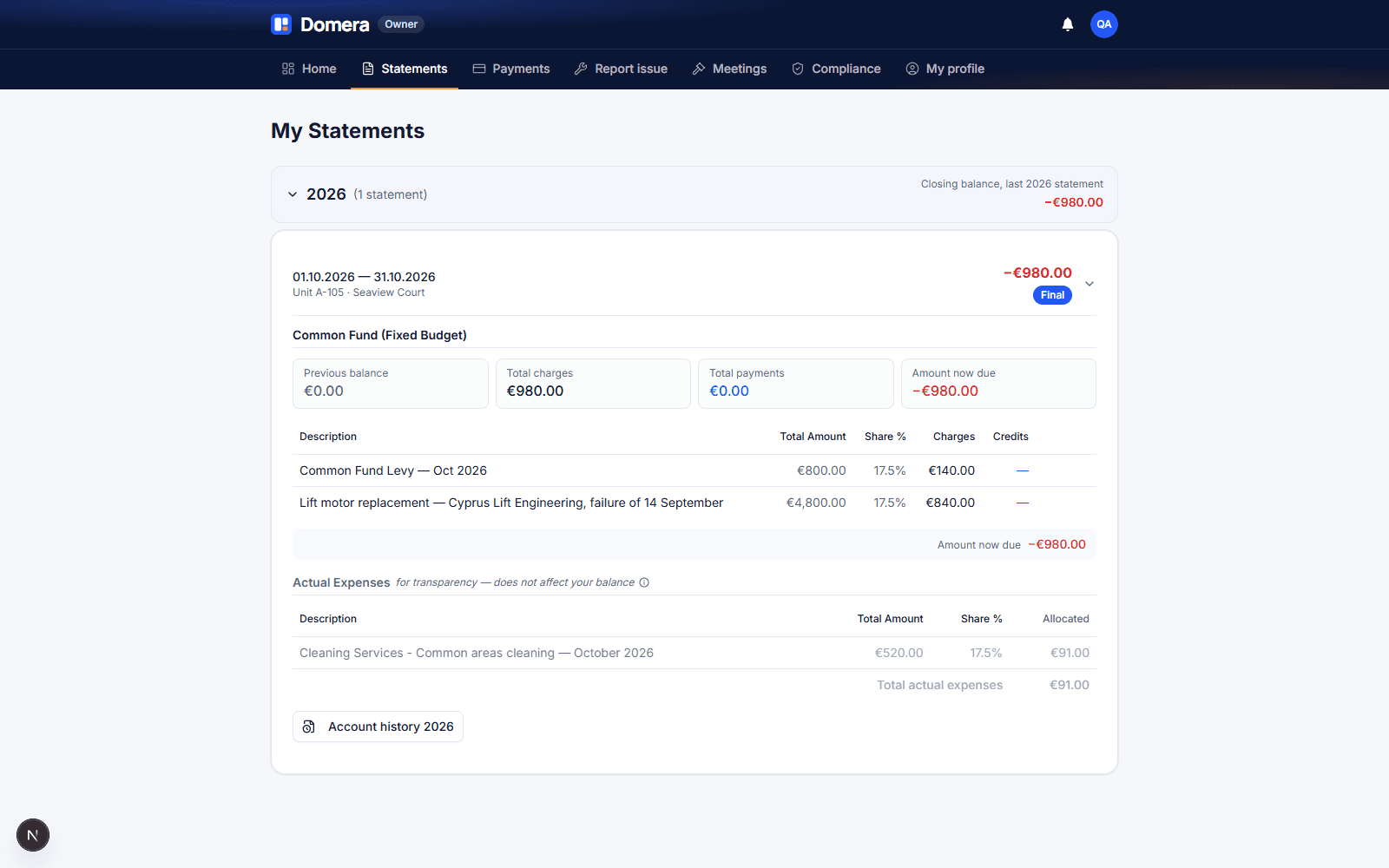
The statement does not change shape. Under Common Fund (Fixed Budget) the owner sees the month's levy line and, below it, a line with the contribution's title, for example "Lift motor replacement", or "Facade crack survey · instalment 1 of 3" when it is spread, with the amount and the unit's share of that instalment. Both lines are charges; both are in the total and the amount now due. The information section below lists the month's actual invoices as before, minus the one the contribution recovers.
The owner portal and the PDF read the same data, and the unit page's upcoming-levies note names the contribution rather than just "Common" when the next levy row is one. An owner who wants to check the figure can: the share printed on the line is their share of that instalment across all units, which matches their ownership share, or the exact amount the committee decided.
The reserve variant, and what stays information only
If the invoice belongs to a reserve fund category, or the contribution is created for the reserve fund, the rows go to the reserve levy table and the line appears under Reserve Fund on the statement, added to the owner's reserve balance. That is the right home for a one-off top-up voted to rebuild the fund after a roof job, or for a planned capital item the fund cannot yet carry. How much reserve fund a building should hold is the longer discussion.
Everything the committee does not charge on top stays exactly as it was: paid from the fund, listed for information, never added to a balance. Cancelling a posted contribution is possible while none of its rows has reached a statement, and removes the rows; after that the statement is the record, and a correction is a credit on the next one. A posted contribution cannot be edited; cancel it and create the right one. Neither the monthly budget levy nor a share change touches a posted contribution: it is the record of a decision, not a calculation to be redone.
Checklist
- Decide which of the three options fits, and minute it: absorb, raise the levy, or a one-off extra.
- Record the invoice with the decision in the description, then choose Charged to owners on top of the levy.
- Check the split rule, the instalments and the first statement month in the preview before saving.
- Fill in who authorised it and when; attach the invoice and the quotes.
- Approve the invoice; the contribution posts and appears under Settings › Finance › Contributions.
- Generate the month's statements and read one owner's statement: levy line, contribution line, no repeated invoice.
- For an extra that does not start with an invoice, create it on the Contributions tab and link the invoices it recovers.
Frequently asked questions
- Is the extra contribution added to the owner's balance straight away?
- It is posted straight away and billed on the next statement generated for that month, which is when it joins the balance and the amount due. Until then it shows as not yet billed. Owners are never asked for an amount that is not on a statement.
- Can I spread a large cost over several months?
- Yes, from one to twenty-four monthly instalments starting from the first statement month you choose. Each unit's share is split into the instalments with the cent remainder on the first, so the instalments add up exactly, and every monthly statement carries that month's part under the contribution's title.
- Will the owners see the invoice twice?
- No. An invoice linked to a contribution is left out of the actual-expenses information section on the statements that bill the contribution. The owners see one line, the extra contribution, with the invoice's title and their share.
- What if the committee changes its mind?
- While none of the contribution's rows has reached a statement, cancel it; the rows are removed and nothing is charged. Once a row is on a statement, the statement is the record: the contribution cannot be cancelled, and a correction is a credit on a later statement. Reverting the invoice to draft follows the same rule.
- Does this work in an actuals-mode building?
- It is not needed there and the choice does not appear. In actuals mode every approved invoice is already charged to the owners as it is posted, so an extra contribution would charge them twice.
- Does the monthly budget levy change?
- No. The budget levy and a contribution are separate rows and the levy engine only ever looks at budget rows, so a contribution in October does not replace or suppress October's levy. If the cost is recurring rather than one-off, revise the budget and the levy instead.