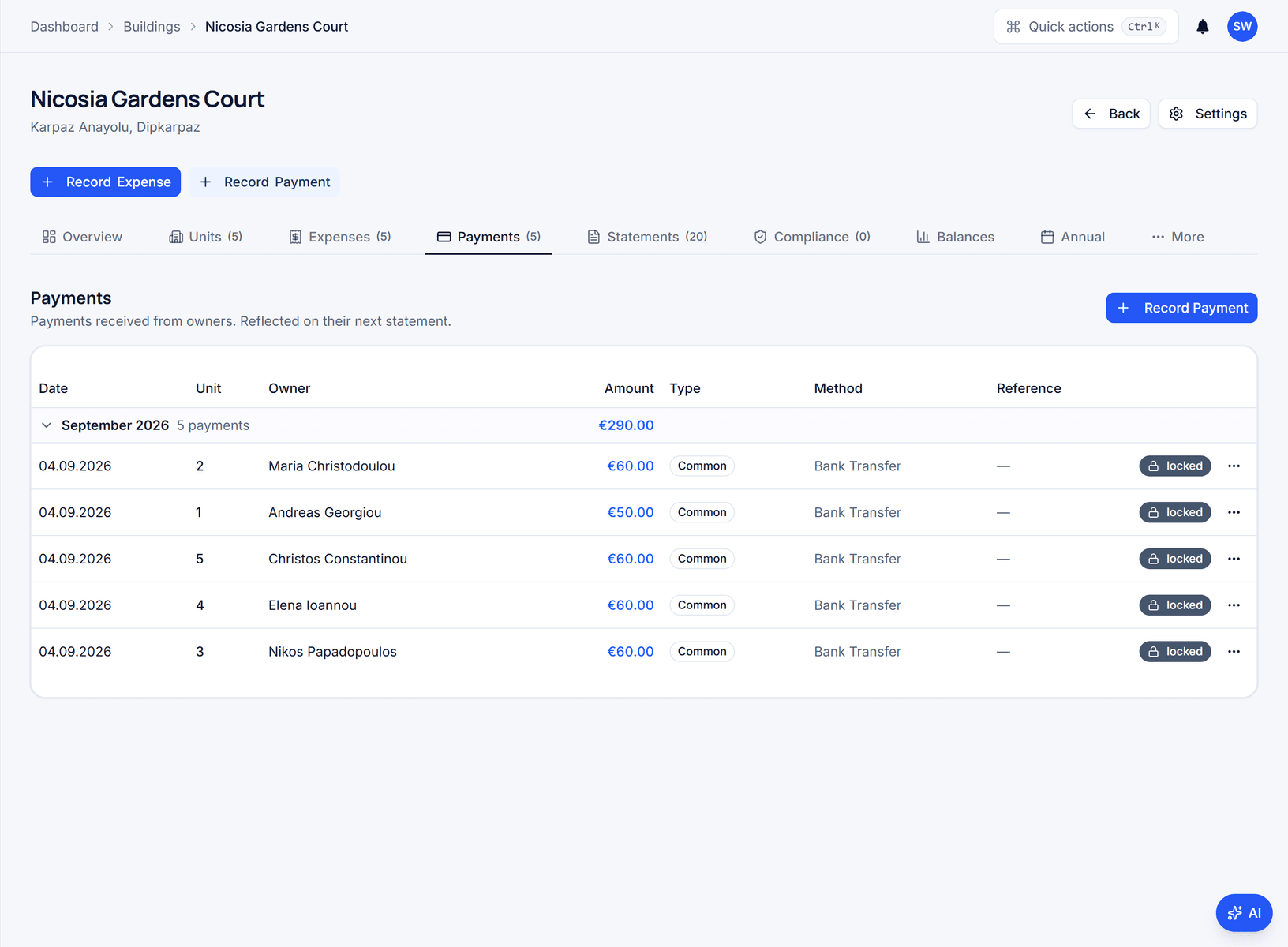
Payment Reconciliation
Record payments with transaction-safe allocation logic and accurate rounding across owners and units.
A single owner payment often needs to be split across common expenses, reserve contributions, and outstanding balances from previous periods — and every cent matters. Domera records payments with transaction-safe allocation logic that preserves cent-level accuracy using largest-remainder rounding. The system automatically distributes incoming amounts across the correct accounts and updates owner balances in real time. Teams can see exactly how each payment was applied, which periods it covered, and whether any outstanding balance remains. This precision eliminates the reconciliation disputes that consume hours every billing cycle.
Maintain reliable balances with fewer posting and reconciliation disputes.
Why Payment Accuracy Is Critical
In building management, payment errors compound. A one-cent rounding discrepancy per owner per month becomes a noticeable variance by year-end. When an owner makes a partial payment that needs to cover common charges, reserve contributions, and arrears, the allocation logic must be precise and defensible. Spreadsheet-based reconciliation is error-prone at this level of complexity, especially across buildings with different allocation rules. Domera's payment engine was designed specifically for multi-account building finance where precision is a requirement, not a nice-to-have.
Transaction-Safe Allocation Logic
When a payment is recorded, Domera applies it to the correct accounts using the building's allocation rules. The system uses largest-remainder rounding to ensure that split amounts always sum exactly to the payment total — no floating-point drift, no unallocated cents. Payments are processed atomically: either the full allocation succeeds or nothing is posted, preventing the half-applied transactions that corrupt balance integrity. Teams can see the exact breakdown of how every payment was distributed across owners and fund types.
Balance Visibility and Statement Alignment
Once a payment is applied, owner balances update immediately across both the management dashboard and the owner portal. Statement generation picks up the latest payment context automatically, so owners see accurate balances without manual adjustments. Historical payment records remain available for audit purposes, showing the allocation path for each transaction. This end-to-end visibility means that balance questions can be answered in seconds rather than reconstructed from bank statements and spreadsheets.
Handling Complex Payment Scenarios
Real-world payments are messy. One transfer might cover three months of arrears plus the current period. A committee member might pay on behalf of another owner. A bank transfer might arrive with a different reference than expected. Domera supports these scenarios with flexible payment recording that preserves the link between the received amount and its application across accounts. This flexibility reduces the workarounds that teams normally build in spreadsheets and keeps the audit trail clean.
Why Teams Use This Feature
Prevents reconciliation drift in shared payments
Handles owner-level allocation automatically
Keeps payment history transparent for statements
Atomic payment creation workflows
Largest-remainder split logic
Outstanding balance monitoring


Keep Exploring
Ask questions about your buildings in plain language and get instant answers. Create expenses, look up balances, and get financial insights through a conversational AI.
Learn MoreAutomatically split shared building expenses using ownership share, unit area, fixed shares, or custom business rules.
Learn MoreGive owners secure, read-only access to statements, balances, payments, and building documents in one portal.
Learn MoreFrequently Asked Questions
Ready to simplify building expense management?
Start your 14-day free trial and set up your first building in minutes.